Last Updated: January 15, 2026
There was a time when deleting social media felt extreme.
It meant disappearing. Missing out. Being out of the loop. Friends would ask if something was wrong. Employers might even question it. Social platforms weren’t just apps; they were infrastructure. If you left, you felt like you were stepping outside modern life.
That assumption no longer holds.
In 2026, deleting social media has quietly become normal. Not universal. Not celebrated everywhere. But common enough that it no longer raises eyebrows—especially in the United States, Germany, and the United Kingdom.
What’s interesting isn’t that people are leaving. It’s why they’re leaving, and what they’re finding on the other side.
This isn’t a moral movement. It isn’t anti-technology. Most people deleting social media are not going offline entirely. They still use smartphones, messaging apps, search engines, streaming platforms, and AI tools.
They’re just stepping away from something that no longer feels worth the cost.
For years, social media sold a simple promise: connection.
Share your life. See others’ lives. Stay informed. Stay social. Stay relevant.
But by the mid-2020s, that promise began to feel thin.
People didn’t wake up one day and decide social media was bad. The shift was gradual. Subtle. A growing sense that the relationship had changed, and not for the better.
Feeds became louder but less meaningful. Content became faster but more disposable. Conversations felt performative instead of human. Even joy began to feel staged.
In the US, many users describe it as exhaustion. In Germany, the language is often about control and privacy. In the UK, people talk about pressure and emotional weight. Different cultures, same underlying feeling.
Something was off.
Is This “Meta AI Using Your Chats/Media” Rumor True?
One of the biggest turning points was the rise of AI-generated content.
By 2026, large portions of social feeds are no longer created by people sharing moments from their lives. They are generated, optimized, recycled, and scaled. Posts designed to trigger reactions, not connection. Images that look real but aren’t. Videos engineered to hold attention rather than convey meaning.
Users may not consciously identify what’s happening, but they feel it.
The feed no longer feels like a place where friends talk to friends. It feels like a machine talking at you.
People scroll longer and feel less satisfied. They consume more and remember less. They close the app feeling oddly empty, irritated, or numb.
This isn’t accidental. Platforms are built to maximize engagement, not fulfillment. The algorithms don’t care if you feel better. They care if you stay longer.
By 2026, more people understand this—not as a theory, but as lived experience.
Another major factor is mental health, but not in the way headlines usually frame it.
This isn’t just about anxiety or depression, though those matter. It’s about constant psychological load.
Social media demands attention in fragments. Notifications interrupt thought. Trends shift daily. Outrage cycles never finish. You’re expected to have an opinion on everything, immediately, and in public.
Even passive use carries weight. Seeing curated lives day after day subtly alters how people measure their own progress, relationships, bodies, and success. Comparison becomes ambient. You don’t notice it happening, but it shapes how you feel.
In Germany and the UK especially, there has been a growing cultural pushback against this kind of mental noise. People value depth, privacy, and boundaries. Social media increasingly conflicts with those values.
Deleting an app becomes less about escape and more about regaining mental space.
Privacy concerns also play a larger role than before.
In the early days, data collection felt abstract. People knew platforms tracked behavior, but it didn’t feel personal. By 2026, that has changed.
AI personalization has made data usage visible. Ads reflect conversations too closely. Content recommendations feel uncomfortably accurate. People realize that their moods, habits, fears, and interests are being continuously modeled.
In Germany, where privacy culture is deeply rooted, this has accelerated social media fatigue. Many users are uncomfortable with the idea that casual scrolling feeds massive behavioral datasets.
In the US and UK, the concern is less philosophical and more practical. People are tired of being treated as data points rather than users.
Deleting social media becomes a form of quiet resistance. Not dramatic. Just intentional.
There’s also a generational shift happening.
Younger users, especially Gen Z and Gen Alpha, do not relate to social media the same way millennials once did. They grew up inside it. They understand the mechanics intuitively. They’re less impressed by follower counts and less interested in public identity performance.
Many younger users now prefer:
- Private group chats
- Small communities
- Temporary platforms
- Anonymous or low-profile spaces
Public feeds feel exposed. Permanent. Risky.
Older users, meanwhile, are questioning whether the time investment still makes sense. They’ve experienced years of platform changes, algorithm shifts, and broken promises. Loyalty has eroded.
The result is a rare overlap: different generations, leaving for different reasons, at the same time.
Another overlooked reason people are leaving is productivity.
Social media fragments attention in a way few other tools do. It doesn’t just consume time; it disrupts focus.
People trying to work, learn, or create find it increasingly difficult to coexist with constant feeds. Even when not actively scrolling, the awareness of notifications pulls mental energy away from deeper tasks.
In 2026, as remote work, freelancing, and self-directed learning become more common, attention becomes valuable. People start protecting it.
Deleting social media is often framed as a productivity experiment. Many are surprised by the results.
They don’t suddenly become superhuman. But they notice fewer interruptions, longer stretches of focus, and a calmer mental baseline.
That alone is enough to keep the apps off their phones.
What’s striking is what doesn’t happen after people delete social media.
They don’t disappear.
They don’t lose all their friends.
They don’t become uninformed.
Instead, communication shifts.
Messaging apps replace feeds. News becomes intentional rather than ambient. Relationships deepen with fewer people rather than spreading thin across hundreds.
Many report a strange realization after a few weeks: they don’t miss it as much as they expected.
The fear of missing out turns out to be weaker than the relief of mental quiet.
This doesn’t mean social media is dying.
Platforms still have billions of users. Influencers still exist. Businesses still rely on reach and visibility. Social media remains powerful.
But its role is changing.
In 2026, social media is increasingly treated as a tool rather than a place to live. People log in for specific reasons and log out again. Or they step away entirely, without announcing it.
The cultural narrative has shifted. Deleting social media is no longer seen as antisocial. It’s often seen as self-aware.
Perhaps the most important change is this: people are no longer blaming themselves.
In the past, users felt guilty for scrolling too much, comparing themselves, or feeling drained. They thought the problem was lack of discipline.
Now, many recognize that the systems are designed this way.
Deleting social media becomes less about self-control and more about setting boundaries with technology that is very good at taking more than it gives.
In the end, the trend isn’t about rejection. It’s about recalibration.
People aren’t abandoning connection. They’re redefining it.
They aren’t rejecting technology. They’re choosing which parts deserve their time.
And in 2026, more people than ever are deciding that infinite feeds, constant performance, and algorithmic pressure are not worth the trade.
Not loudly.
Not dramatically.
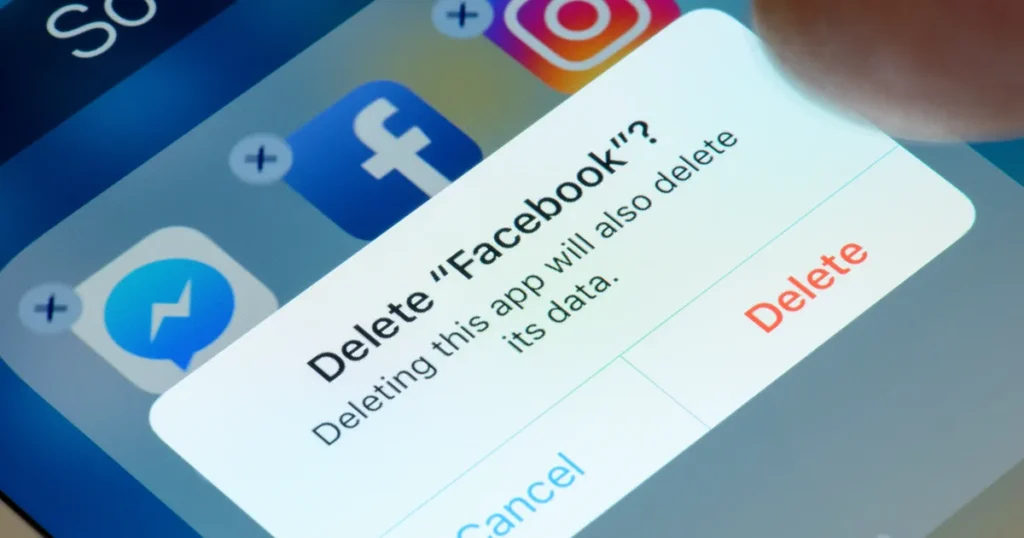
Just quietly, one deleted app at a time.