
Last Updated: January 20, 2026
🌟 Introduction
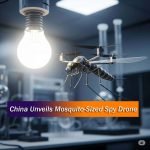
China has once again demonstrated its commitment to becoming a global leader in next-generation military and surveillance technology. The National University of Defense Technology (NUDT) recently unveiled a mosquito-sized spy drone at an internal defense technology exhibition, creating waves across the global intelligence community.
This development is not science fiction. Micro aerial vehicles (MAVs) have been under research by the US, Israel, and European nations for over a decade. However, China’s demonstration indicates it has achieved a breakthrough in miniaturization and functional deployment.
🐝 What Is the Mosquito Drone?
The drone, approximately 1-2 centimeters in body length, is modeled on the flight aerodynamics of real mosquitoes. It features:
✅ Micro-camera module: enabling image and potential video capture
✅ Directional MEMS microphone: capturing audio from a narrow field
✅ Four-micro-rotor propulsion system: stabilizing hover with six-axis control
✅ Real-time RF communication chip: transmitting data securely
✅ Battery capacity: ~10 minutes per charge (current prototype)
✅ Weight: under 500 milligrams, lighter than a standard paperclip
Its wings or rotors are translucent and minimal in noise output, making it almost undetectable to humans unless under direct light reflection.
🔬 Technical Challenges Overcome
Building a true insect-scale drone involves numerous engineering challenges:
- Power supply miniaturization
The lithium micro-battery required must be powerful enough for lift yet small enough to fit the insect frame. - MEMS propulsion stability
Standard drones rely on heavy stabilizers. MEMS-based rotors and AI-controlled gyroscopes ensure it remains steady mid-air. - Signal processing latency
Micro drones require near-instant signal processing to avoid oscillation instability due to size and rotor inertia. - Payload integration
Combining camera and mic with microprocessors within a sub-1g frame is a significant achievement.
🛡️ Strategic and Military Implications
While still at prototype stage, this drone opens up multiple strategic possibilities for China:
🚨 Covert Surveillance
The drone can infiltrate secure compounds, embassies, or military bases undetected, recording audio-visual data.
🚨 Urban Intelligence Gathering
It can monitor suspected terrorists or criminals indoors without traditional bugs or cameras, circumventing security systems.
🚨 Target Acquisition Support
In battlefield conditions, micro drones can help identify enemy positions inside buildings or bunkers.
🚨 Psychological Warfare
The mere knowledge of such drones being deployed induces paranoia and operational insecurity in targets.
Video about this Mosquito-Sized Spy Drone
🌐 Global Reactions and Comparisons
🔍 US & Israeli programs
- The US DARPA-funded Black Hornet Nano drone (developed by Norway’s Prox Dynamics, acquired by FLIR) is roughly 10cm long, much larger than this mosquito drone.
- Israel’s Tactical Robotics division has bee-sized micro drones, but none matching sub-2cm operational prototypes for mass deployment.
🔍 China’s ambition
This development aligns with China’s broader “civil-military fusion” doctrine, integrating civilian academic R&D with military needs, aiming for technological parity or superiority against Western adversaries by 2030.

⚠️ Privacy and Ethical Concerns
Security experts worldwide warn that mosquito drones pose severe risks:
❌ Invasion of privacy
Can record private conversations and video without detection.
❌ Espionage and sabotage
Corporate espionage becomes easier, especially in industrial R&D labs.
❌ Difficulty in countermeasures
Traditional anti-drone jammers are ineffective against such small RF signatures; detection requires specialized radars or acoustic arrays.
🧠 Expert Commentary
Li Wei, lead engineer at NUDT’s micro-robotics lab, stated:
“Our design uses nature’s aerodynamic secrets to achieve unprecedented stealth and maneuverability in micro aerial vehicles.”
Dr. Scott Shepherd, US defense analyst, commented:
“This is not a toy. It represents a leap in covert surveillance capability. While battery life limits range today, future versions with energy harvesting or micro fuel cells could operate indefinitely.”
🔮 Future Developments
China’s Ministry of National Defense has not confirmed deployment timelines. However, leaked internal slides suggest:
- Phase 2 (2026): Incorporate micro chemical sensors for biological or environmental monitoring
- Phase 3 (2028): Swarm deployment for area denial, crowd surveillance, or micro-attack (using toxin delivery)
Such weaponization remains highly controversial under international law.
📊 Comparison Table
| Feature | China Mosquito Drone | Black Hornet Nano (US/NATO) |
|---|---|---|
| Length | 1-2 cm | 10 cm |
| Weight | < 0.5 g | ~18 g |
| Flight Time | ~10 min | ~25 min |
| Camera | Micro HD still | Live video (day/night) |
| Control Range | ~200-300 m | ~1.6 km |
| Main Use | Covert indoor surveillance | Tactical soldier reconnaissance |
✈️ The Bottom Line
The unveiling of a mosquito-sized spy drone places China among the leaders in biomimetic robotics and miniaturized surveillance technology. Although real-world deployment is limited by battery and signal constraints today, continuous improvements in micro-batteries, energy harvesting, and AI navigation will make such tools standard in espionage arsenals within the decade.
As with many emerging defense technologies, the ethical and legal frameworks struggle to keep pace with innovation. The challenge for global security is to balance national defense interests with human rights and privacy protection.
Read here too – Flux.1: New AI Image generator

I just like the helpful information you provide in your articles
This is really interesting, You’re a very skilled blogger. I’ve joined your feed and look forward to seeking more of your magnificent post. Also, I’ve shared your site in my social networks!